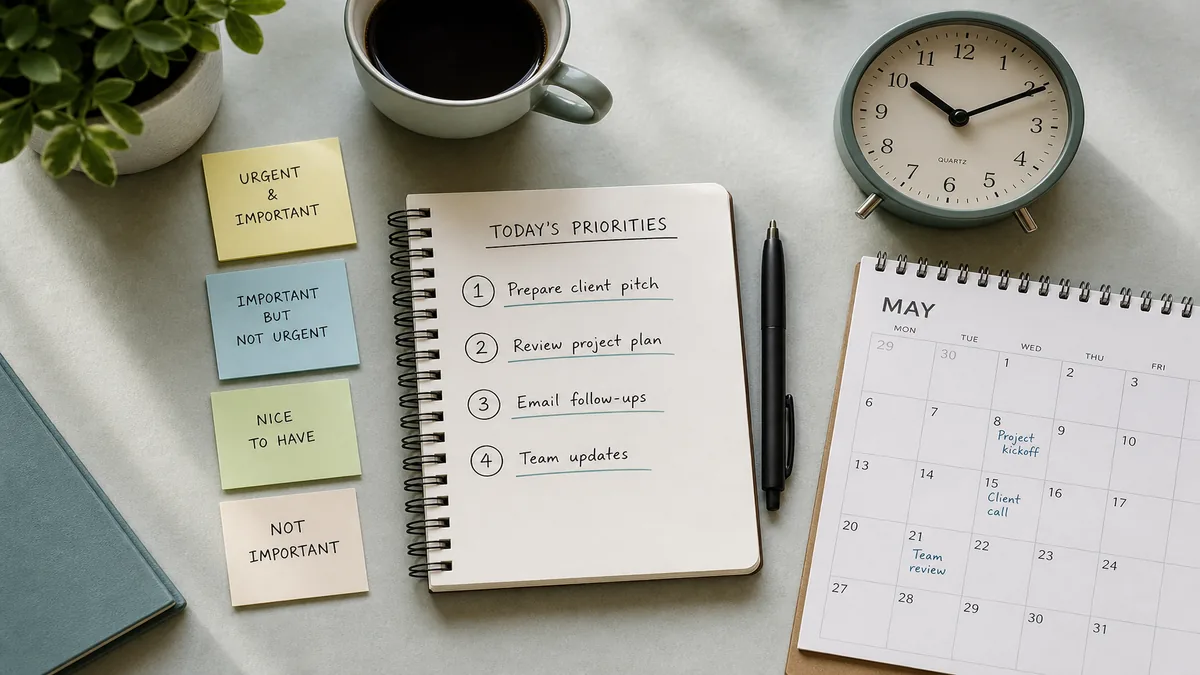
Prioritizing tasks is hard when everything looks important. If you rank only by importance, work with nearer deadlines slips, and the day ends in last-minute stress.
Priority is not the order of what you feel like doing. It is the order of what should move first inside the time you actually have. This article explains a practical way to prioritize by deadlines and remaining time.
Why prioritization often fails
When priorities keep collapsing, the decision rules are usually unclear.
- Important-looking work comes first, while nearer deadlines get missed
- Only due dates are compared, not usable remaining time
- Large tasks are delayed because they feel heavy
- Tasks that match your mood win over tasks that matter today
- Completion criteria are vague, so today's true needs stay unclear
Deadline management also starts from remaining time rather than the calendar date alone. Prioritization becomes more stable with the same lens.
Start with the shortest remaining time
When tasks look equally important, check remaining time first. "Due tomorrow" can mean tomorrow morning or tomorrow night, and those are very different amounts of usable time.
- Tasks with the shortest remaining time
- Large tasks that will miss the deadline if ignored today
- Tasks that block other people or the next step
- Tasks that make tomorrow easier if you move them a little today
This order reduces the chance that "important but still distant" work steals the day. Making remaining time visible makes the comparison even easier.
Compare workload as well as the deadline
Even with the same remaining time, a five-minute check and a two-hour document are not equal priorities. Near deadlines plus large workloads need an earlier time block.
- Short remaining time × large workload → start first
- Short remaining time × small workload → finish quickly and close it
- Long remaining time × large workload → advance a portion today
- Long remaining time × small workload → safe to wait
The dangerous pattern is delaying large work because "there is still time." That habit often leads to last-minute deadline panic.
Limit today's priorities to three
A long priority list does not mean everything fits into today. Daily decisions get easier when you narrow them to three.
- Must finish today: 1 task
- Must reach more than halfway today: 1 task
- Start if time remains: 1 task
Everything else can wait until tomorrow or later. Think less about "doing it all" and more about choosing today's winning path.
How to spot tasks that can wait
Prioritization also means deciding what not to do first. These tasks can leave the front of today's list.
- There is enough remaining time before the deadline
- Nobody else is blocked
- Today's submissions do not depend on finishing it
- It feels productive but does not move real outcomes
When you defer something, leave a start point. Deferring without a next time is just another form of delay.
Use Kotomit for deadline-based prioritization
Kotomit is a task management app that shows remaining time until each deadline as a countdown. By lining up deadline-based missions, you can prioritize by time instead of by feeling.
With Kotomit, you can:
- Register deadline-based tasks as missions
- Choose today's work from shorter remaining time first
- Avoid putting distant but important work ahead of nearer deadlines
- Review why something missed and improve the next ranking
Priority is not fixed once. As remaining time changes, the order should change too. Keeping deadlines visible every day makes those updates harder to miss.
Summary
Good task prioritization uses deadlines, remaining time, workload, and impact—not importance alone. Keep today's list to three items, and give deferred tasks a clear start point.
When you feel stuck, check the shortest remaining time first. Once the distance to each deadline is visible, what to do now becomes clearer.