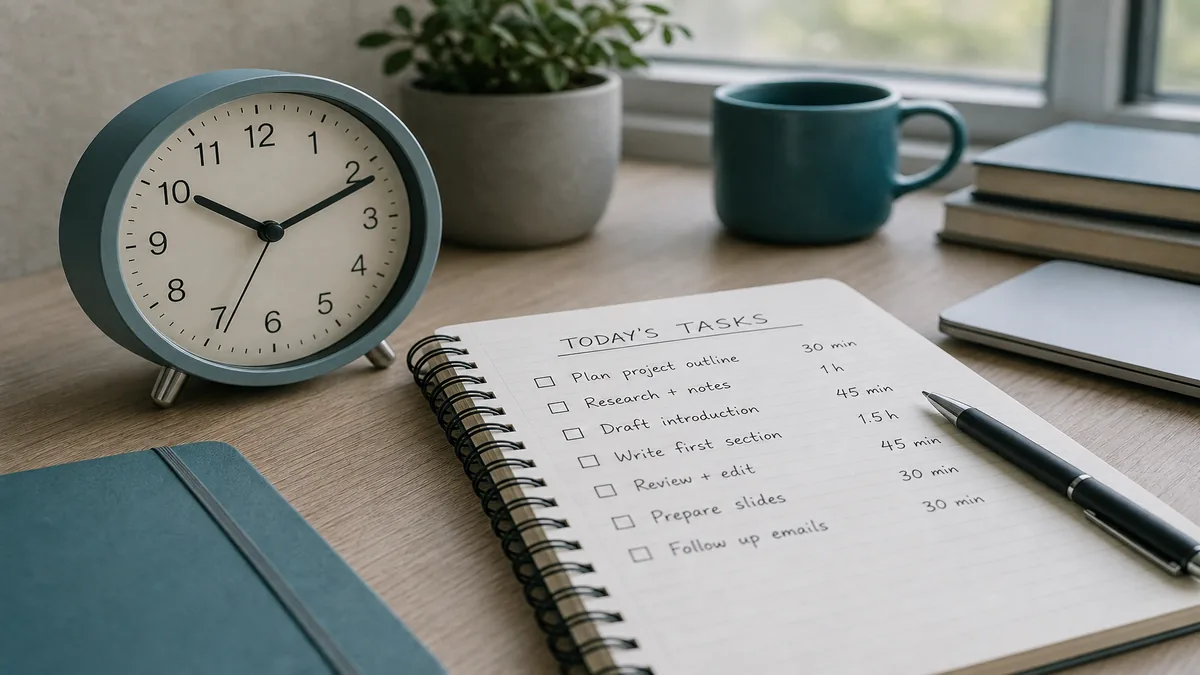
Work often runs late not because of low motivation, but because the time estimate was too optimistic. A task you expected to finish in 30 minutes takes an hour, and the rest of the day slips. This happens more often than most people admit.
When estimates are wrong, tasks feel easier than they are, so starting gets delayed and the deadline becomes stressful. Procrastination guides also treat underestimating required time as a common cause of last-minute rushes. This article focuses on practical ways to make time estimates more realistic.
Why task time estimates go wrong
Missed estimates usually follow the same patterns.
- The task is treated as one vague block, so the real steps are never counted
- The estimate assumes ideal focus and uninterrupted work
- Review, fixes, submission, and waiting time are left out
- Past results are ignored, so every estimate is based on gut feeling
- The gap between estimate and actual time is never recorded
The goal is not to guess perfectly every time. The goal is to change how you estimate, knowing that optimistic guesses will miss.
Break the work into smaller steps
Large labels like "prepare slides," "submit an application," or "write a report" hide how long the work really takes. Splitting the task into steps makes missing time visible.
- Prepare slides → outline / draft / add visuals / review / submit
- Submit an application → check requirements / fill forms / gather attachments / submit / wait for reply
- Study → confirm the scope / solve questions / review mistakes
Estimate each step in minutes, then add them up. A total built from small pieces is usually closer to reality than one big guess.
Estimate from past results
Gut estimates often lean on your best days. Using similar past work as a baseline improves accuracy.
- How long did a similar task take last time?
- What was the difference between a smooth day and a slow day?
- Is this familiar work, or something new?
If you have no history yet, avoid the ideal number. Use a slightly padded estimate. First-time work usually needs more setup and decision time than expected.
Include interruptions, review, and revision time
Estimating only the core work almost always undercounts. Real tasks include time around the main activity.
- Interruptions from messages or conversations
- Review time or waiting for feedback
- Fixes, formatting, and resubmission
- Setup, prep, and context switching
If drafting takes 40 minutes and review takes 20, the estimate should be at least 60 minutes. Making remaining time visible also helps you notice how these surrounding costs affect the schedule.
Record the gap between estimate and actual time
Estimation accuracy improves through feedback, not one perfect guess. Keep the difference between plan and result, then use it next time.
- Estimate: 30 minutes / Actual: 50 minutes
- Gap: +20 minutes
- Reason: searching for materials took longer than expected
Over time, patterns appear, such as "I usually underestimate research time." These notes are not for self-blame. They are raw material for better planning.
Review why the time ran out
If a task overruns and you only say "I was busy," the same problem returns. Naming the reason makes the next fix concrete.
- Poor estimation: the amount of work was underestimated
- Overloaded: too many tasks were active at once
- Wrong prioritization: another task took the available time
- Late start: starting late reduced usable time
- Unexpected work: extra issues appeared mid-task
- Lack of focus: interruptions or distractions piled up
Once the reason is clear, the next action is clearer too: break the work down, reduce parallel tasks, or decide the start time earlier.
Use Kotomit to track remaining time and failure reasons
Kotomit is a task management app that shows remaining time until each deadline as a countdown. It helps you manage deadline-based missions and review what went wrong when a plan slips.
With Kotomit, you can:
- Register deadline-based tasks as missions
- Check remaining time throughout the day
- Record why a mission timed out
- Use patterns like poor estimates or late starts in the next plan
When remaining time stays visible, optimistic estimates are harder to ignore. When failure reasons are recorded, the same miss is less likely to repeat.
Summary
Better task time estimates come from breaking work into steps, using past results, including interruption and review time, and reviewing the gap between estimate and actual time.
When plans slip, revise the assumptions behind the estimate instead of blaming yourself. Keeping remaining time and failure reasons visible helps the next schedule move closer to reality.